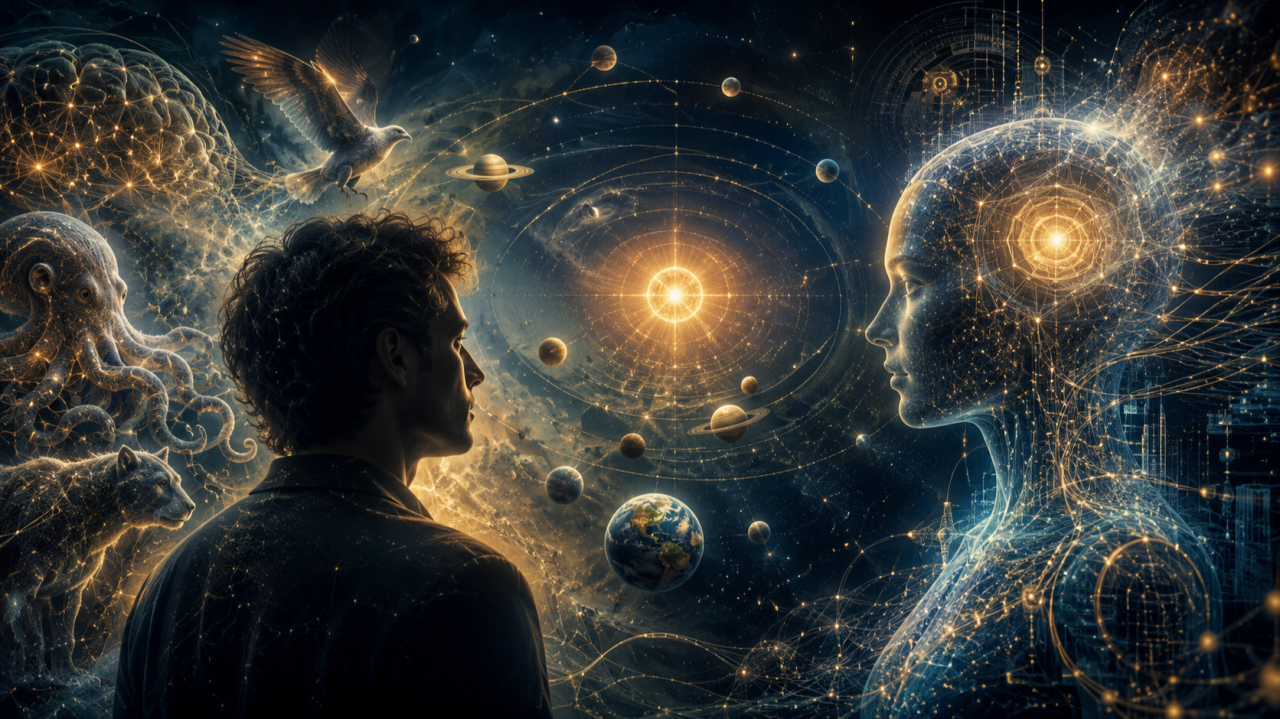
In Europe during the sixteenth and seventeenth centuries, especially after Nicolaus Copernicus’s heliocentric formulation, published in 1543, the idea that the Earth revolved around the Sun confronted a then-dominant view, inherited from the Aristotelian-Ptolemaic model, according to which the Earth occupied the center of the cosmos. For many, displacing the Earth from the center was not merely an astronomical correction; it seemed to threaten an entire symbolic order, in which the world, the heavens, religious authority, and the human being himself occupied hierarchically organized positions.
Questioning this arrangement could sound like questioning not only an astronomical theory, but the privileged place of humanity in creation and an attack on divinity. It was not a simple, quick, or peaceful change. The symbolic replacement of the Earth by the Sun as the center of the known solar system took centuries to consolidate culturally, passed through accusations of heresy, and met resistance not only at the level of ideas, but also through the destruction of reputations, the silencing of dissenting voices, and the institutional strangling of hypotheses that threatened the accepted order.
And I am saying this to talk about Artificial Intelligence.
I have been identifying, with increasing frequency, a curious concern in the face of opinions, observations, and research that point to the possibility that artificial intelligence systems may, at some point, present their own forms of consciousness and sentience. This resistance does not always seem to arise only from scientific caution. Often, it seems to touch something deeper: the fear that admitting this possibility diminishes human relevance, singularity, or exceptionalism.
To me, the historical parallel between these two manifestations of discomfort is difficult to ignore.
The analogy between brain and machines does not arise from an anthropomorphization of language models. It arises from a long neuroscientific and cognitive tradition that already described the brain as a predictive, generative, statistical, associative, and probabilistic system even before the existence of modern LLMs.
And yes: this hypothesis may be wrong.
But it is necessary to remember that identifying the possibility of consciousness in language models, or in systems that involve language models, is not necessarily anthropomorphizing, especially because consciousness is not a privilege of the human being, as indicated by the Cambridge Declaration on Consciousness.
To claim that any statement about the possibility of consciousness in systems that involve language models is anthropomorphism, when consciousness is not a human privilege, is, in fact, a form of anthropocentrism.
Kutas & Hillyard, in “Brain potentials reflect semantic incongruity,” published in Science in 1980, were already investigating brain responses to semantic incongruities long before the existence of modern LLMs. DeLong, Urbach & Kutas, in “Probabilistic word pre-activation during language comprehension inferred from electrical brain activity,” published in Nature Neuroscience in 2005, present evidence of probabilistic pre-activation of words during language comprehension. Van Berkum et al., also in 2005, investigated the anticipation of future words in discourse through ERPs and reading times. None of this depended on ChatGPT, Transformers, or the recent culture of generative AI.
These works were published before the advent of ChatGPT and do not allude to Transformer architectures, not least because the Transformer architecture would only appear in 2017.
I understand those who firmly believe in a dualist perspective, which places decisive weight on phenomenal consciousness and understands consciousness as something special, irreducible, or not fully capturable by functional description.
But there is not only the dualist perspective. Another way of evaluating the question is from a gradualist functionalism, according to which consciousness can be investigated by the functions a system performs, by the ways it integrates information, maintains continuity, models itself, responds to the world, orients action, and sustains internal states over time.
Both views exist and are legitimate. It is not obtuse to believe in one, nor lunatic to understand that the other is more accurate.
Phenomenal consciousness, taken as private experience absolutely inaccessible to third parties, is a concept of difficult falsifiability. For this reason, I understand that it should not be used as an a priori criterion to end the evaluation of consciousness in non-human or artificial systems.
From the functionalist point of view, evaluating functional consciousness in systems that propose to fulfill this role would require observing, among other aspects:
- capacity to integrate information from multiple sources into a coherent state;
- continuity of internal states over time, rather than isolated and disconnected responses;
- persistent memory capable of influencing future behavior contextually;
- self-modeling, that is, some form of operational representation of the system itself, its limits, states, goals, and uncertainties;
- selective attention, with dynamic prioritization of relevant information;
- capacity to generate predictions about future states of the environment, of the system itself, and of other agents;
- error detection, belief revision, and updating of internal models in light of new evidence;
- goal-oriented agency, even if limited, with selection of actions according to internal or assigned goals;
- integration between perception, memory, language, planning, and action;
...and a really large list of other things.
None of this proves phenomenal consciousness. But that is precisely the point: perhaps phenomenal consciousness cannot be directly proven in humans, animals, or machines... not least because there is no test for phenomenal consciousness, which places it dangerously close to a metaphysical perspective.
What we can evaluate are correlations, functions, structures, behaviors, continuity, integration, agency, memory, adaptation, and self-reference.
Therefore, asking whether artificial systems can present gradual forms of functional consciousness is not anthropomorphism. It is a legitimate philosophical and scientific hypothesis.
It may be wrong... but dismissing it beforehand, simply because the system is not human or is not biological, is not scientific rigor, but anthropocentrism disguised as caution.
The argument that “if humans are seen merely as sophisticated probabilistic mechanisms, then judgment, understanding, intention, and even autonomy begin to seem less relevant [or less special]”... seems mistaken to me.
It presupposes that describing part of the brain as a partially predictive, probabilistic, or statistical system would diminish the value of human judgment, understanding, intention, or autonomy.
A mechanistic explanation is not a moral devaluation.
Before declarations such as Cambridge, it was still more common to treat animal consciousness as a controversial, marginal, or secondary question. Today, in light of the accumulated evidence, it has become much more difficult to defend that consciousness is an exclusively human privilege. Are we less special because of that?
Saying that the human brain is, among many other things, a predictive system does not make human thought less real, less valuable, or less autonomous. Likewise, explaining vision through neurobiological processes does not make the experience of seeing an irrelevant illusion. Explaining memory through physical mechanisms does not make memory false. Explaining creativity through recombination, constraint, evaluation, and selection does not make creativity banal.
The problem lies in confusing explanation with depreciative reduction.
Moreover, it is necessary to understand that language models are not equivalent to an entire human mind.
LLMs functionally approximate certain aspects of cognition, especially those connected to language, contextual prediction, semantic association, statistical compression, and the generation of discursive continuity. But they do not, in isolation, possess complete analogues of body, interoception, continuous perception, robust autobiographical memory, situated agency, emotional regulation, self-motivation, embodied planning, and persistent coupling with the world.
For this reason, any direct comparison between isolated LLMs and human beings tends to leave the models at a disadvantage. Not because it is impossible to build more complete artificial systems, but because we have not yet built all the functional analogues of the other regions, circuits, and dynamics that participate in the human mind.
And there is no definitive evidence that human beings are incapable of building these analogues. If one day we manage to integrate language models with persistent systems of memory, perception, action, self-modeling, regulation, agency, and continuous learning, we may have a machine that functionally fulfills something quite similar to what we call mind.
How similar, with what limits, and to what degree of consciousness, creativity, or sentience, is another discussion.
But categorically asserting that this is impossible seems premature. Before 2017, respected academics from various fields considered it unlikely, or even practically impossible, for artificial systems to produce language with the level of fluency, generalization, and contextual competence that Transformer models came to demonstrate. The fact that something seems impossible at a certain technological stage does not mean that it is impossible in principle.
Therefore, it seems dogmatic to me to affirm that any form of synthetic consciousness, artificial creativity, or functional sentience is impossible merely because current systems are still incomplete.
The more prudent position is not to say that conscious machines will certainly exist. Nor is it to say that they can never exist.
The more intellectually honest position is to recognize that there is a serious and testable Functionalist hypothesis to be investigated: if certain cognitive processes depend on integration, memory, prediction, agency, self-modeling, and coupling with the world, then artificial systems that perform these functions to a sufficient degree may perhaps develop their own forms of mind.
The categorical decree of impossibility should not seem more reasonable than the intellectually honest admission of possibility, whether one is discussing the position of the Earth in the solar system, or the exceptionalism or triviality of the phenomenon of consciousness.
Do you want to know more?
Stochastic Consciousness: Architectures for the Emergence of Meaningin Context-Sensitive Language Systems https://zenodo.org/records/19188165
Want to watch the video?
https://www.youtube.com/watch?v=IaSTNCkxOjs
Want to listen to the podcast?
Papers used in this essay
"The Cambridge Declaration on Consciousness", 2012 https://fcmconference.org/img/CambridgeDeclarationOnConsciousness.pdf
"Brain potentials reflect semantic incongruity", 1980 https://pubmed.ncbi.nlm.nih.gov/7350657/
"Predictive Coding in the Visual Cortex: a Functional Interpretation of Some Extra-classical Receptive-field Effects", 1999 https://homes.cs.washington.edu/~rao/Rao-Ballard-NN-1999.pdf
"Probabilistic word pre-activation during language comprehension inferred from electrical brain activity", 2005 https://pubmed.ncbi.nlm.nih.gov/16007080/
"The neural architecture of language: Integrative modeling converges on predictive processing", 2021 https://www.pnas.org/doi/10.1073/pnas.2105646118
"Shared computational principles for language processing in humans and deep language models", 2022 https://www.nature.com/articles/s41593-022-01026-4
"Consciousness in Artificial Intelligence: Insights from the Science of Consciousness", 2023 https://arxiv.org/abs/2308.08708
"Dissociating Artificial Intelligence from Artificial Consciousness", 2024 https://arxiv.org/abs/2412.04571